
Posted on: January 26, 2026 / Last updated: January 26, 2026
The Growing Reality of Non-Operating Terminals and Rising Port Skipping Risks
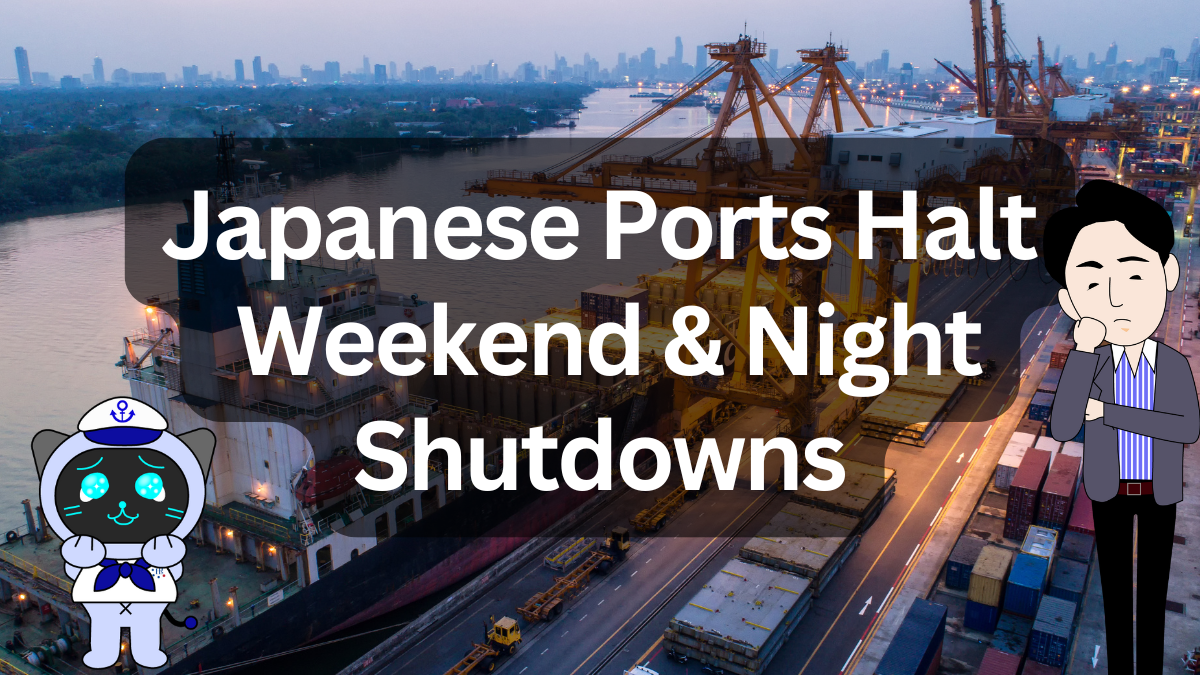
Japan’s ports are facing a serious structural challenge.
Due to labor shortages and work style reform pressures, more ports are choosing to stop cargo handling at night and on weekends.
Ports are often assumed to operate 24/7.
However, across regional ports in Japan, terminals are intentionally reducing operating hours in order to survive.
This shift is already affecting vessel schedules, cargo lead times, and long-term supply chain reliability.
CONTENTS
Watch the Video Here
Ports Are Intentionally Reducing Operating Hours
Japan’s port labor shortage has reached a critical point.
As a result, several container terminals have begun suspending night operations and weekend cargo handling.
According to Maritime Press reports, examples include the following.
- Hakata Port introduced a night operation suspension trial starting autumn 2024.
- Kitakyushu Port Taichu Terminal suspended Sunday operations and closed gates on Saturdays from February.
- Tomakomai Port reduced RTG crane operations and cut simultaneous vessel handling from three to two.
- Otaru Port will fully close container yards on Saturdays from April.
These measures are not isolated cases.
They represent a nationwide trend from Kyushu to Hokkaido.
Why Is This Happening Now
The causes behind this issue can be summarized into three structural factors.
Labor Shortages and Work Style Reform
Japan’s aging population has led to a chronic shortage of port workers.
At the same time, stricter overtime regulations mean terminals can no longer rely on extended working hours to cover labor gaps.
What was once absorbed by overtime is now operationally impossible.
Vessel Upsizing and Schedule Disruptions
Modern container vessels are significantly larger.
Each port call now involves handling far more containers than before.
Additionally, delays caused by weather and overseas port congestion have become common.
This leads to multiple large vessels arriving simultaneously.
With limited manpower, terminals simply cannot cope with these sudden workload spikes.
Recruitment and Retention Challenges
Younger workers prioritize work life balance.
Night shifts and weekend work are major deterrents for recruitment.
To prevent further attrition and attract new talent, port operators are choosing to stop operations during unfavorable hours.
Short Term Pain and Long Term Survival
In the short term, shippers and carriers will face reduced convenience.
Cargo movement will slow and lead times may increase.
However, from a long-term perspective, this may be a survival strategy.
By concentrating manpower on weekdays, some ports are already seeing productivity improvements.
Higher efficiency during operating hours can reduce vessel delays.
Reducing operating hours does not always reduce efficiency. In some cases, it improves it.
The Biggest Risk Is Port Skipping
The most serious concern is Japan port skipping.
If carriers determine that Japanese ports are inconvenient or slow, they may choose to bypass them.
Cargo could be routed through Busan or major Chinese hubs instead.
Once a port loses its regular calls, regaining them is extremely difficult.
A Two Speed Future for Japanese Ports
Looking ahead, Japan’s ports may split into two distinct paths.
- Regional ports will limit operating hours and maximize weekday efficiency through automation and DX.
- Major ports such as Keihin and Hanshin will attempt to maintain 24 hour operations but face rising labor risks.
The assumption that ports operate around the clock is no longer guaranteed.
Shippers must design supply chains with greater buffers and flexibility.