
Posted on: January 30, 2026 / Last updated: January 30, 2026
Is Japan Falling Behind Global Standards? The Reality of Port Automation and Structural Barriers
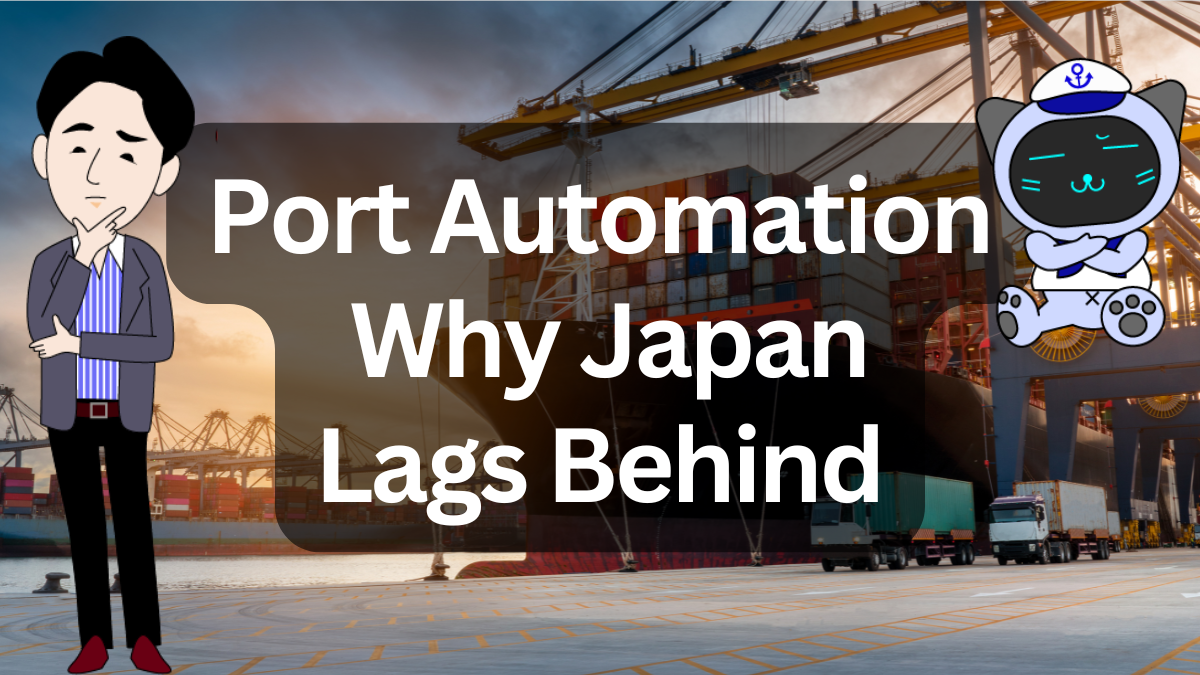
Port automation is accelerating worldwide.
However, Japan is increasingly at risk of being left behind.
The so-called “2024 labor issue” is often discussed in the context of trucking.
In reality, the same labor shortage is already reaching a critical level at Japanese ports.
CONTENTS
Watch the Video Here
Global ports are moving toward automation as the norm
Globally, port automation and remote-controlled cargo handling are becoming standard practice.
According to government data, 17 of the world’s top 20 container ports have already introduced automation technologies.
New terminals are now designed with automation as a prerequisite rather than an option.
Why automation is accelerating worldwide
The reasons are clear.
First, automated equipment can operate 24 hours a day without interruption.
Unlike human labor, machines do not suffer fatigue or scheduling constraints.
While peak productivity may sometimes be lower than skilled human operators, automation provides stable and predictable performance.
Second, automation dramatically improves working conditions.
Remote operation allows workers to control cranes from climate-controlled offices, expanding employment opportunities to women, older workers, and injured veterans.
Why Japan struggles to adopt full automation
Despite these global trends, Japan has only introduced limited remote operation in certain terminals.
Full-scale automation remains rare.
There are three major structural barriers.
Barrier 1: Labor union negotiations
Automation raises concerns about job security worldwide.
International port labor unions have openly opposed automation, warning of strikes if employment is threatened.
In Japan, protecting established job roles carries particular weight, making consensus-building slow and complex.
Barrier 2: Cost and ROI challenges
Automation requires massive capital investment.
With inflation and a weak yen, equipment costs have surged.
At the same time, Japanese port workers are already highly skilled.
As a result, automation does not always guarantee higher productivity, making return on investment uncertain.
Barrier 3: Existing infrastructure constraints
Japanese ports use a variety of handling systems, including RTGs and straddle carriers.
Government subsidies often assume specific equipment types, meaning full automation may require complete infrastructure redesign.
What lies ahead for Japan
Rapid full automation is unlikely in the short term.
However, maintaining the status quo is not an option as labor shortages deepen.
The realistic path forward is a hybrid model that combines partial automation with remote operation to support human workers.
Ultimately, the key question is cost-sharing.
If shipping lines, port operators, and cargo owners cannot agree on how to fund modernization, Japan’s port competitiveness will continue to decline.