
Posted on: February 3, 2026 / Last updated: February 3, 2026
MSC Strengthens Japan Services as the Industry Enters a Full Transshipment Era
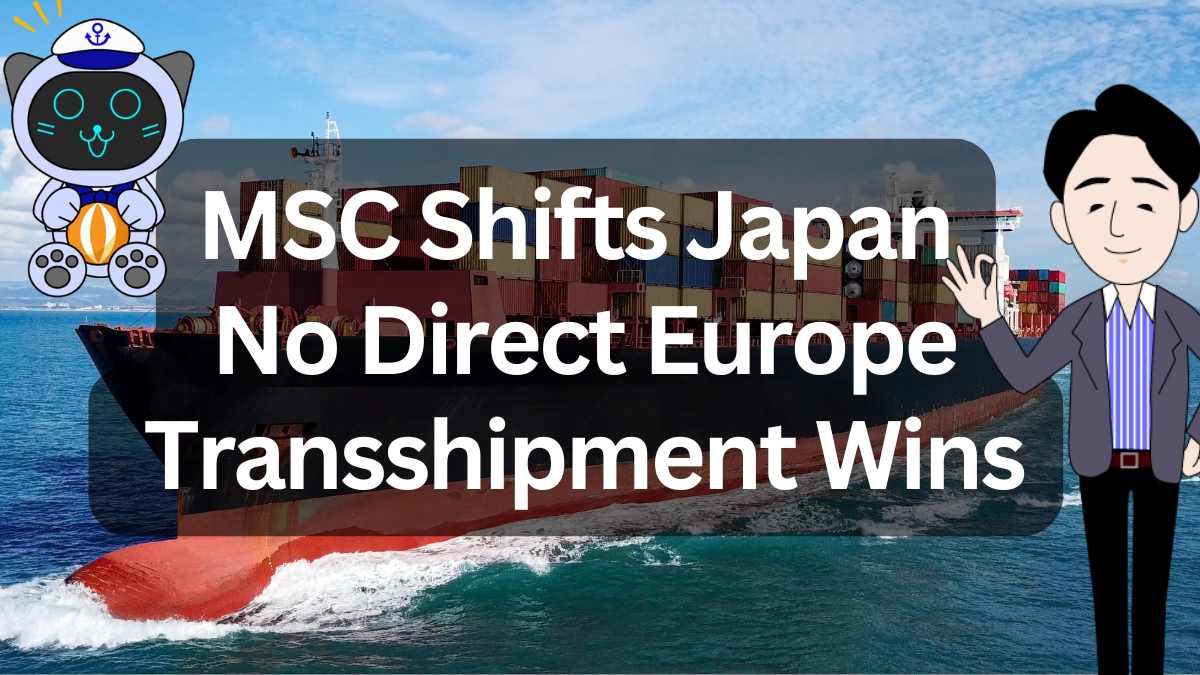
Recent developments in the container shipping industry suggest that Japan’s position in global logistics is quietly but decisively changing.
One of the clearest signals comes from MSC, the world’s largest container carrier, which has announced plans to further strengthen its Japan-related services.
At first glance, this may seem surprising, given the long-standing narrative of “Japan passing” in global shipping networks.
However, a closer look at MSC’s strategy reveals that Japan is not being sidelined, but rather repositioned within a new structural framework.
CONTENTS
Watch the Video Here
“We Can No Longer Handle All Japan Cargo” — A Telling Remark
The turning point was an interview with the president of MSC Japan.
In that interview, he stated that under the current service structure, MSC is no longer able to fully accommodate growing Japan-origin cargo volumes.
This remark is significant.
For years, the industry has assumed that Japan’s cargo base was shrinking, making it less attractive for direct calls by ultra-large container vessels.
Yet MSC, with the world’s largest fleet capacity, is now describing Japan as a market with excess demand rather than declining relevance.
How MSC Is Structuring Its Japan Network
After dissolving the 2M Alliance, MSC moved to a fully independent operating model.
Within this framework, the carrier has built Japan-focused services that emphasize connectivity rather than direct calls.
- ORIGAMI: Linking Japan with Singapore and onward to East Africa
- KAGUYA: High-frequency feeder connections via Busan
- SUNRISE: Services designed specifically to maximize Japan cargo intake
These services may appear unconventional, but they are strategically consistent.
MSC is prioritizing reliable global connections over symbolic direct sailings.
Europe Trade: The End of the Direct Call Era
The most important structural shift lies in the Europe trade.
From 2026 onward, Japan–Europe services will effectively become 100 percent transshipment-based.
With carriers such as ONE and other alliance members ending direct Japan calls, all shippers will operate on the same playing field.
The selection criteria will shift toward:
- Quality of hub port connections
- Accuracy of transshipment schedules
- Speed and reliability of disruption recovery
For MSC, this is a favorable environment.
The carrier has refined hub-and-spoke operations for more than 25 years, making transshipment its core competence.
Strategic Focus Shifts from East–West to North–South
Another key pillar of MSC’s strategy is its strong emphasis on North–South trade lanes.
Rather than concentrating solely on mature East–West routes, MSC is expanding capacity toward Africa and South America.
Through its subsidiary Africa Global Logistics (AGL), MSC offers integrated inland logistics beyond the port gate.
This ability to control both maritime and inland logistics gives MSC a structural advantage in emerging markets.
What This Means for Shippers and Forwarders
For logistics practitioners, the implications are clear.
Carrier selection will no longer depend on whether a service is “direct.”
Instead, the focus must shift to connection quality, network redundancy, and response capability during disruptions.
In a fully transshipment-based Europe trade, diversification of routing and carrier options becomes an essential risk management tool.
Conclusion: Japan as a Feeder Market, Not a Declining One
Japan may no longer serve as a primary origin for mainline services.
However, this does not signal decline.
It marks a transition toward a role defined by connectivity rather than direct access.
MSC’s strategy suggests that Japan-origin cargo remains highly competitive when integrated into a robust global network.
Understanding carrier network philosophy will become a critical skill for supply chain professionals going forward.