
Posted on: February 4, 2026 / Last updated: February 4, 2026
Why PCTC Capacity Remains Tight in 2026 Despite New Vessel Deliveries
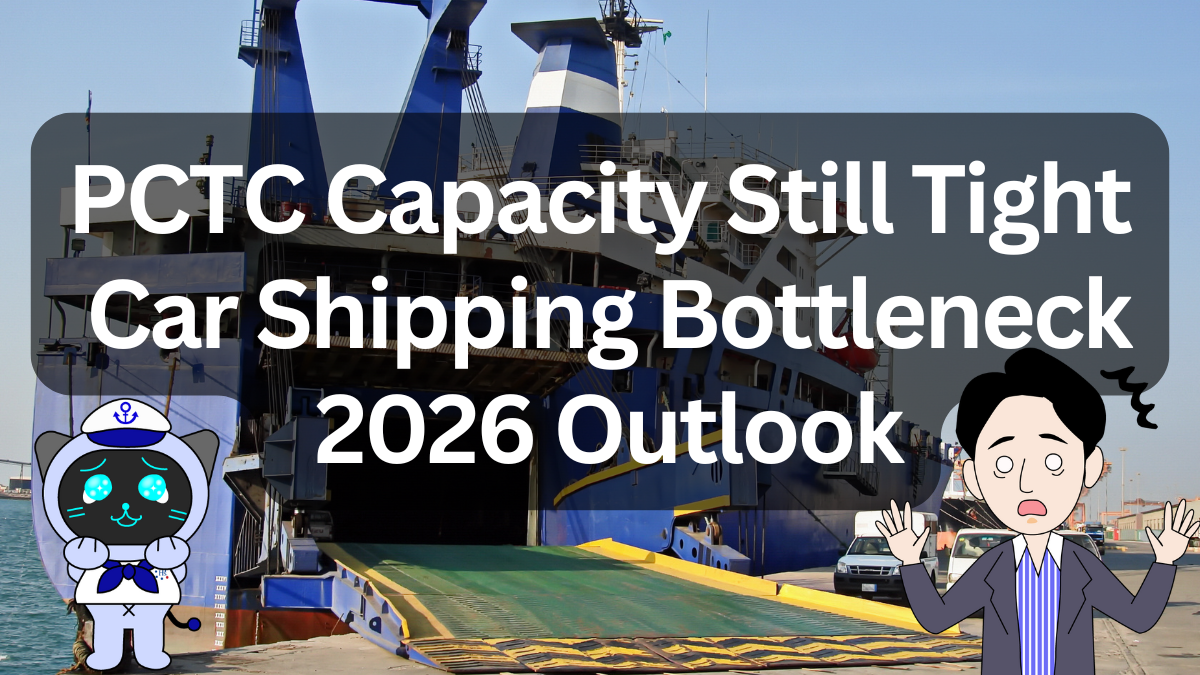
Many in the logistics industry expected capacity pressure in the PCTC market to ease by now.
A large number of new pure car and truck carriers were delivered between 2024 and 2025, and on paper the fleet size has clearly increased.
However, entering 2026, tight vessel availability for car carriers remains a structural issue.
According to analysis from NYK Group and recent maritime press coverage, the imbalance between supply and demand is likely to persist.
CONTENTS
Watch the Video Here
Why Capacity Is Still Constrained
So why does the shortage continue even as the fleet grows.
The answer lies in several structural factors that reduce effective transport capacity.
Factor 1 Severe Export Import Imbalance in Asia
The most critical issue is the extreme export import imbalance in Asia.
Traditionally, vehicle exports from East Asia exceeded imports by roughly three to four times.
With the rapid expansion of Chinese vehicle exports, this ratio exceeded five to one in 2025.
Exports 5 Imports 1 Empty return voyages 4
In shipping, one way cargo flows result in poor asset utilization.
A five to one imbalance forces many vessels to return in ballast, significantly reducing fleet efficiency and available space.
Factor 2 Longer Transport Distances
Export destinations have expanded from regional markets to Europe and Latin America.
In addition, Red Sea security concerns have forced many vessels to reroute via the Cape of Good Hope.
Although the detour adds only six to seven percent in distance, long haul routes amplify the impact.
As a result, vehicles occupy vessels for longer periods, lowering fleet rotation speed and tightening capacity.
Factor 3 Aging Fleet Limits Net Supply Growth
Another key factor is fleet aging.
The average age of the global PCTC fleet now exceeds fifteen years, the highest level on record.
- More than sixty percent of vessels are over sixteen years old
- Older vessels are likely scrapped as new ships enter service
Even with new deliveries, scrapping offsets capacity growth, preventing oversupply.
Outlook for 2026 A Sellers Market Continues
The conclusion is clear.
PCTC capacity constraints will continue in 2026.
Even if the Suez Canal situation stabilizes, excess vehicle production in China will sustain export pressure.
Additionally, vehicles previously moved by container ships due to shortages are likely to return to car carriers, creating rebound demand.
Implications for Logistics Practitioners
Shippers and forwarders should plan based on the following assumptions.
- Longer lead times
- Early space booking
- Diversification of carrier options
Finished vehicle logistics has entered an era where physical transport capacity itself is the bottleneck.
This reality will continue to shape the market throughout 2026.